Sunday, October 16, 2016

Meet the company of The Life and Death of Jack Straw!

Cynthia Alice (Lord Morton, Tax Collector) lives in Red Bank, New Jersey. Stage: Shadow Kids (Doris Brown); Measure For Measure (Francisca, Justice, Whore); Dead Man's Cell Phone (Mrs.Gottleib), Titus Andronicus (Nurse, Goth, Tribune), Sure Thing (Betty), Happy Mug (Carole); Macbeth (Lady Macbeth). Screen: Perception (Mother), Bromance Boys (Real Estate Agent); Close Your Eyes (Mrs. Brume), Hold The Mayo (Mom); Lou (Julia).


Alexis Ebers (Gentleman Usher, Sir John Newton) is thrilled to be taking part in Bad Quarto's latest production! Alexis was most recently seen in the Off-Broadway musical Crashlight at the Cherry Lane Theatre. She is a graduate of the Maggie Flanigan Studio Two-Year Meisner Conservatory Program. Other credits include: The Christians (Playwrights Horizons), The Fire Raisers as the Doctor of Philosophy (Ovalhouse Fringe Theatre, London), Company as Amy (Hope Players), and Les Miserables as Cosette (Curtain Call Inc.). Alexis is looking forward to being in the next hit comedy web series and/or singing her way from Ellen's Stardust Diner to Broadway (or Off-Broadway, or a tour, or a staged reading, I'm not picky)


Katie Fanning (Wat Tyler, County Salisbury) is excited to be working with Bad Quarto! Previous work includes Rosalind (As You Like It), Trinculo (The Tempest), and Katherine (Henry V) with Adirondack Shakespeare Company; Hermione (The Winter's Tale) and Arsinoe (The Misanthrope) with Underling Productions; Margery Pinchwife/Maggie (The Country Wife/The C*nt) with Spicy Witch Productions. BFA: NYU. Thanks to John for support and muffins


Courtney M. McClellan (Lord Mayor, the Queen Mother, and the Southwerkman) excitedly joins the cast of The Life and Death of Jack Straw for her third production with Bad Quarto after What Lamb, What Ladybird and The Second Shepherds' Play (Gill/Mary). Recent NY credits include: As You Like It (La Belle/Phoebe) with Shakespeare Off-Broadway, Green Sound (Taylor) with the Greenhouse Ensemble, Whatchamacallit (Disciple) with the Skeleton Rep, and Ripper (Lizzie/Mrs. Lusk). Regional Credits: Hamlet (Gertrude), The Comedy of Errors (Adriana/Courtesan), Romeo and Juliet (L. Montague/L. Capulet/Benvolio), Macbeth (Witch/Malcolm), and A Midsummer Night's Dream (Titania/Helena/Quince) with NC Shakes; One Flew Over The Cuckoo’s Nest (Nurse Flinn), A Raisin in the Sun and Once on This Island in Nashville, TN; Chicago (Mama Morton), Big River (Alice), and The Sound of Music (Sister Berthe) with Weathervane Playhouse (Newark, OH). BA Communications/Theatre, Hampton University; McCaskill Studios, NYC

Madeleine Morrell (Nobs) is extremely thrilled to make her NYC debut in Bad Quarto's production of The Life and Death of Jack Straw. She has previously worked at Shakespeare and Co. in Lenox, MA as an actor and composer and is incredibly ecstatic to start making her dreams come true here. A huge thanks to her friends and family for the constant support they've given her. This one's for all of you!


Katharine Nedder (Lord Treasurer, Hob Carter) is an NYC based actress and recent NYU Tisch grad, holding a BFA in Acting. She last appeared in AlphaNYC's Twelve Angry Women as juror 10 and in the Thespis Festival's In Manhattan as Baby. Additionally, she is a voice artist for SpokenLayer and a preschool soccer coach.


James Overton (Parson Ball, Spencer, Flemming) has most recently appeared performing with New Hampshire's Shakespeare in the Valley as Launce in Two Gentlemen of Verona as well as Oberon and Theseus in A Midsummer Night's Dream. This will be James' third time working with Bad Quarto Productions, having appeared in Hamlet, The First Quarto, and The Taming of a Shrew. Other NYC Theatre credits include: Twelfth Night, Little Red in the Hood: And Other R-Rated Shorts and And Then There Were None. He received his Bachelor's Degree from Bennington College where he starred in Don Juan, and Myths and Hymns.


Maria Pleshkevich (King Richard II) is a senior at Fordham University at Lincoln Center. This is her second show with Bad Quarto Productions, having appeared in last year's The Taming of a Shrew as Christopher Slie. She has most recently appeared in in Yara Arts Group's Dark Night, Bright Stars at LaMaMa Experimental Theatre, and her other LaMaMa theatre credits include Hitting Bedrock and Winter Light. She has performed internationally at the Edinburgh Fringe Festival (Pandora's Box), in Granada, Spain (La Ratita Presumida), and in Kyiv, Lviv, and Odessa, Ukraine (Dark Night, Bright Stars). She is the percussionist in Korinya: Ukrainian Folk Band, and plays bandura in the Women's Bandura Ensemble of North America


Alanah Rafferty (Lord Secretary, Tom Miller) is an actor, writer, director and producer from Mamaroneck, NY. She graduated from Marymount Manhattan College with a degree in Communication Arts and Philosophy. Her off Broadway stage credits include So You Think You're Godd, A Moment in Time, and Mirrors and Smoke. This year she starred in her first feature film, Cat's Kill, slated for release in 2017, and directed her first short film, Grey Matters, for The New Agenda Foundation. Alanah wants to thank her family, friends, colleagues and mentors for all of their support and wisdom. For more information, visit alanah-rafferty.com.


Andre Silva (Jack Straw, Archbishop) is a New York based actor. He recently finished an intensive course at the Royal Academy of Dramatic Arts (RADA). He has been seen in Bad Quartos productions of Hamlet, The Taming of a Shrew and The Second Shepherds Play, and in Daniel Adams production of Three Sisters at the Alchemical Theater Laboratory. He is delighted to be a part of this cast and wants to thank his friends and family for their ever growing support! www.AndreSilva.info


Alex Dabertin (Asst. Director) is a writer, actor, and director living in New York City. He is really excited to continue his work with Bad Quarto Productions as the Assistant Director of The Life and Death of Jack Straw and to dive into some of the most important political issues of our time. Alex could most recently be seen in Bad Quarto's production of the first quarto of Hamlet as Hamlet, and directed the company's production of What, Lamb! What, Ladybird! this past summer. He wants to thank Tony for these wonderful opportunities and Elizabeth for being so good.





Monday, September 26, 2016

Jack Straw: A Literary Prequel and a Plea

The Life and Death of Jack Straw is not one of the best known plays of the early modern period (and that may be an understatement), but fans of Shakespeare will be familiar with the historical circumstances of the period, and of peasant rebellions, through the works of Shakespeare: most notably Richard II, 1 Henry VI, 2 Henry VI, 3 Henry VI. The events preceding the deposition of Richard II are almost the same as those surrounding the usurpation of Henry VI, and echoes of those events could certainly be heard in the last decade of Elizabeth I's reign.

Richard II's portrait at Westminster Abbey, ~1495.

Jack Straw serves as a literary prequel to Shakespeare's Richard II. The events of Jack Straw take place in the early years of Richard II's reign, and lay the foundation for the events Shakespeare depicts in that king's eponymous play. In Jack Straw we see Richard II, little more than a child, and hopelessly overwhelmed by the concept and the practical requirements of kingship: he would rather be praying than ruling. Richard blushes at the thought of his subjects dealing with him so rudely and brazenly, but he is also squeamish about punishing them. Richard is so out of his element here that his mother comes to the site of the rebellion to advise him. 

The Death of Wat Tyler from Jean Froissart's Chronicles (15th c.).
Richard II's incompetence is on display in Shakespeare's play, but Jack Straw gives us the chance to see the foundation for the  Richard's deposition. Where Shakespeare gives us a glimpse of Richard's inefficacy in Richard II; Jack Straw more completely paints a portrait of events that plunged England into 80 years of civil war. And that is a portrait that was especially important in the early 1590s: the royal succession was doubtful, and Elizabeth I was gaining in years. Elizabeth's military campaigns in France and the Nine Years' War was just beginning in Ireland, and a new generation of leaders were governing on the privy council, and Elizabeth increasingly relied on spies and propaganda to maintain the illusion of peaceful and stable governance. 

In 1593 (or 4), Jack Straw wouldn't have just been a literary prequel to the Shakespeare's English histories, it was also a plea to prevent history from repeating itself. Given that Shakespeare was himself writing his earlier English histories at that time, he seems to have had similar concerns. 

Wednesday, September 7, 2016

A Look Back at Directing "What, Lamb! What, Ladybird!"

Directing What, Lamb! What, Ladybird! was a learning experience for everyone, myself included. There are three concrete lessons about directing and theater production that I took away with from the experience.

The first is that simplicity is your friend, but it requires infinitely more planning. The script for WLWL switches  between scholarly discourse, Shakespearean drama, and contemporary relationships, and I felt that the more stripped down the set and the action, the better the audience would be able to follow the narrative. Simple staging creates visual tropes quickly, and it is nearly impossible to establish a new performance semiology after the first few minutes of the play: by then the audience has already accepted whatever conventions you’ve established. I had to learn how to be not just simple but utterly clear as well.

From left to right: Sarah Sawyer, Nadia Brown, Keaton Morris-Stan,
and Courtney McClellan in Bad Quarto's production of What, Lamb! What, Ladybird!
by Charlene V. Smith. Directed by Alex Dabertin. 
This understanding let me focus on the essentials of the piece as I saw them: knowledge (embodied in an easel that acted as a primitive slideshow), love (embodied in a set bed), and the body of the actor. By having only these elements in the room, we could play with them and hopefully draw conclusions between them.

This minimalist approach also made a script whose costume and prop changes could have been mechanically impossible relatively easy to organize. It’s the same way that Shakespeare can take you from Egypt to Rome in the amount of time it takes one scene of actors to exit and another to enter.

The second lesson was one of organization and timing. After having previously worked with very good stage managers and producers, I was in charge of scheduling on WLWL. I have never understood the value of my collaborator’s time, or the company’s resources, than when I was put in charge of them. I learned how to manage the time of my collaborators, a lesson that will serve me in good stead in the future when trying to balance the needs of future projects.

From left to right: Dani Martineck, Courtney McClellan, Nadia Brown,
and Sarah Sawyer in Bad Quarto's production of What, Lamb! What, Ladybird!
by Charlene V. Smith. Directed by Alex Dabertin. 
Finally, I learned the value and necessity of collaboration, even in a more isolated environment. I had developed a set list to open the show of what would traditionally be guitar and voice songs, but I neglected to cast a guitarist (purely by accident)  But the cast rose to the occasion. Sarah and Courtney, when staring down the barrel of a pop song, took it upon themselves to do it acapella, which lent the opening a unique emotional tone. In another vein, I had an idea for staging involving an evolving set, and Tony showed me how morphing semiotics could make an audience uncertain about the piece. In all honesty, the best lesson I learned from this experience was the direct product of collaboration. Collaboration is a word I regularly hear spoken, but that I often need reminding of, partly because collaboration often entails letting someone else tweak a small piece of mise en scene (“What if the door were over there?”) when it can do so much more and evolve the whole piece. No matter how good I thought my ideas were, the piece always became better when I had Tony’s input, and the input of my cast.

In addition to these three concrete lessons, I rediscovered something else: I love directing actors. Really digging into a text with them and discovering a way to bring us to the same page, something Bad Quarto’s staging method really made paramount, making the work better and more fun. I am also excited because I will have the chance to apply these lessons as the Assistant Director on Bad Quarto’s upcoming production of The Life and Death of Jack Straw in November.

Wednesday, August 24, 2016

The Meaning of History

I recently wrote about the plethora of history plays that we've been blessed with on some of our most respected stages, and since then I've read handfuls of articles on the topic, but this one got me thinking about our upcoming production here at Bad Quarto: The Life and Death of Jack Straw: A Notable Rebel. If we accept that history is more about the present than it is about the past, and the telling of history tells us more about who we are than who we were, what can the story of the rebel Jack Straw tell us now?

First a little bit of history: Jack Straw is based on the Peasants Revolt of 1381, which was inspired by so many causes that "general uncertainty about the future" is probably the best reason. After suffering the black death, overburdened with taxes due to the Hundred Years' War, and facing the prospect of governance by a weak king (Richard II was only 14 at the time), rebel leader Wat Tyler, inspired by the fiery, what we would call "progressive," political rhetoric of the minister John Ball, led a rebellion that very nearly toppled the throne.

The Death of Wat Tyler at the hands of Walworth, Mayor of London, with
the young Richard II looking on. Library Royal MS 18.E.i-ii f. 175,
dated c. 1385-1400. 

What I find most interesting about Jack Straw is that Straw can, at best, be described as one of the leaders of the rebellion, which is also known as "Wat Tyler's Rebellion." Straw might not even have existed, but he is the focus of this play, first printed in 1593, which was also a time of uncertainty for England. Despite the successes of the English against the Spanish Armada in 1588, bad harvests, plague, and famine followed, and lacking any marriage prospects and approaching 60, Queen Elizabeth I would die childless, leaving the future of the kingdom precarious. There are more than a few parallels between the late 1580s/early 1590s and 1381, and the anonymous author of Jack Straw seems to be speaking those uncertainties, and most specifically the fears of the groundlings, who he seems to target by placing a lesser figure in the rebellion front and center in the play.

The Life and Death of Jack Straw 1593 title page

When Pollack-Pelzner says (in the New Yorker article above)

Commoners must fight for space on Shakespeare’s stage—and it’s not obvious whether the drunkards and prostitutes who populate the tavern where Prince Hal escapes the burdens of court, for instance, serve as rehearsals for responsive sovereignty, critics of royal ideology, or comic baggage to be shed on the way to the throne. It’s hard to know how sympathetically to view Jack Cade’s populist rebellion against the crown in “Henry VI, Part Two”; or the soldier who complains, of Henry V, “When our throats are cut he may be ransomed and we ne’er the wiser”; or the ferocious warrior women, Joan la Pucelle and Margaret of Anjou, who haunt the first tetralogy. Did Shakespeare prop up the royal system that gave him patronage or expose the crown’s hollow core?

He clearly didn't have Jack Straw in mind, and as he argues that Shakespeare's histories are "wedded" to the "great man" theory of history, Jack Straw smiles back at him. And us. Whoever wrote Jack Straw was able to tap into their present fears and anxieties while scaffolding a message that out and out rebellion leads to ruin (no spoilers here: it's right on the title page). With supporters of Donald Trump burning down the Republican Party as we know it, and with a number of Bernie Sanders supporters on the left threatening to do the same thing to the Democrats, I can't help feeling that this is a message we could all stand to hear.

Monday, July 25, 2016

Photos from What, Lamb! What, Ladybird!

Thank you to everyone who joined us for What, Lamb! What, Ladybird! Here are some photos from our performances!


Sunday, July 17, 2016

What Juliet Knows About Love

I have never thought about Juliet as much as I have for this play.

Weird, right? I've been acting in Shakespeare plays for over a decade and I've never taken whatever nascent thoughts I had about Juliet very much deeper than, "I wouldn't play her like that; that's boring. She's so passive there."

Part of that can probably be explained by combined forces of casting and preference that drive me more towards the traditional breeches roles and the clowns. The closest I've been to Juliet before now was in the balcony scene, but as her counterpart. I didn't understand Juliet at all and didn't particularly try. Working on What, Lamb! What, Ladybird! has tapped some vein that was running real deep for a long time, and, to my own surprise, apparently I do have things to say about Juliet! I'm going to try to distill them down into six words.

Ready?

Okay, go.

The band OK GO

Love is a choice that Juliet makes. And makes. And makes again.

Okay, that was eleven words, but the first sentence was six and that's what counts.

Let me explain.

My thoughts about Juliet are impossibly entwined with my thoughts about love. What does it mean to love? What is "true love"? Is the love Romeo and Juliet have really a healthy model of romantic love? There are many more answers to these questions than there is space in this blog post, which is lucky because I don't care about those questions here. I'm not particularly interested in the love between Romeo and Juliet here. When I say love is a choice that Juliet makes, I mean she makes the choice to love herself. Sarah (via Charlene) has a fantastic line towards the end of the play: "[Juliet] trusts...She trusts her own heart."

I can't be the only one to find this a huge deal for a young teenager. That is prime self-doubt time. I was certainly not that self-assured at thirteen. So let's break this down into the three times I think Juliet makes the choice to love and trust herself (and why I love her for it).

Choice 1: Romeo

No, not this Romeo

Romeo is what Juliet had no idea she wanted until he opened his dang smooth-talking mouth. Not because of the smooth-talking, because she probably has actually heard some similar attempts before, being the eligible bachelorette she is. She's never had an equal partner before. She's never been able to spar verbally like this before. She's always been sharper than everyone else in the room. (She still kind of is, but Romeo can at least keep up.) Juliet realizes almost immediately that she wants THIS GUY for her partner and says damn the torpedoes to any and all obstacles. She trusts her choice.

This is not to say that she becomes so single-minded in pursuit of her life with Romeo that everything else in her life loses meaning. Her suffering at Tybalt's death and her parents' machinations is very real, but she doesn't let these overwhelm her focus, which leads me to...

Choice 2: A thing like death

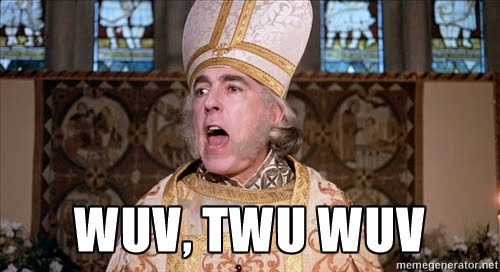
One more Princess Bride meme than you were expecting, right?
It's okay, just roll with it.

To Juliet, marrying Paris and realigning with her nuclear family, forsaking her new family of choice, would be the real death. That would be death and burial of her true self, and whatever lived on with Paris wouldn't be Juliet. So when she's faced with this non-choice, marrying Paris and subsuming herself or retaining herself and subjecting her physical body to starvation on the streets, what does she do? She finds door number three! She creates agency where none is freely available. She goes to the Friar and blackmails him into helping her escape with Romeo. And there's always the chance that something could go wrong here. Cue...

Choice 3: Happy dagger

When the plan falls through, which of course it does, Juliet again has a choice. She can live the rest of her life under someone else's terms by letting herself be found and returned to the Capulets. Or she can live the rest of her life under her own terms by ending it. Having just lost the only thing she was willing to take decisive action to obtain, the person who represented the freedom and the life she was building for herself, she trusts herself again and ends her life on her terms.

But wait, you're thinking, none of these choices seem particularly well-considered. I'm not sure I could fall in love with someone so quickly, or if that would even be love or just infatuation. If they survived long enough to actually live together as a married couple the shine would have gone off of that within a month.

You're right. And that's the whole point. In What, Lamb! What, Ladybird! we mention that the entire action of Romeo and Juliet takes place over just a few days. There's no time for the shine to come off or for anybody to make any considered decisions. These are reactions, not calculations. And that is fascinating to play. Juliet's objectives and through line are amazingly clear, and that makes her actions immediately understandable and relatable, no matter how far from what we would have done they may be.

Thursday, July 7, 2016

New Play, Old Practices: Alex Dabertin on some of the challenges of directing "What, Lamb! What, Ladybird!" for Bad Quarto Productions

Directing What, Lamb! What, Ladybird! is like ice sculpting at thirty-three degrees Fahrenheit. What is normally a process that takes place over the course of weeks gets boiled down to a  decisive moment. Just like Shakespeare and his fellow players, we have only one day to put an engaging and nuanced piece up on its feet. While these staging practices gave rise to some of the greatest plays we know, they are atypical for modern actors and directors.

One of director Alex Dabertin's visual compositions for
What, Lamb! What, Ladybird!
When on a time crunch and in a very controlled space, everything you do will have a genuine impact on an audience. We are performing in a space where the audience is, at most, twenty feet away, although it’s usually closer to two, and so no detail of the performance will go unnoticed.

Every gesture that the cast makes will be noticed, every spoken word heard, and every action seen. In these intimate theatre conditions, the best approach for the director, designers, and cast is to simplify. Simplicity does not mean lack of depth, but often a clearer understanding of the depths of a piece. Only by understanding what is truly important can a director decide what to emphasize, which is especially relevant considering our need to adapt what was originally a one-woman show to suit a five person cast (with the blessing of playwright Charlene V. Smith, of course).

What, Lamb! What, Ladybird! Is a play about love, about one person discovering what love can be, believing that she deserves it. So, then, what lines do the most work in that direction? What costumes or props point us there? Above all, why do they do that work? I also took on the challenge of shaping the play to five people instead of to one, so those questions became more delicate to answer, and the only way to find the answers I was looking for was to work one line at a time.

Asking myself at every line “Why does this help someone understand Juliet and love better?” Then, once I had answered that question, I asked myself “How do I show it?” In another production scenario, I could have played with the whole cast, working with them to discover images. But under these pressure cooker conditions, the director’s role becomes one of planner-in-chief. If I cannot possibly have total control in the moment or let the piece grow of its own volition, I must make sure that everyone is aware of the plan from the very start.

I first concerned myself with the basics of who is onstage and when. Once that was resolved I looked at the props clearly necessary and added what set pieces I thought I needed. This was all done, more or less, in my head as I was editing, as a very first pass.

Once aware of who should be onstage and why, I started diagramming every scene and putting my imagined movements into the script. When I looked at those diagrams, I saw more logistical problems. I worked to solve those, motivating every movement that I could, keeping in mind the readings of the lines my actors have given me. I had a roadmap or the central action of my ice sculpture.

Finally, I was able to turn to the finer points that actually define how the audience will see the play. Some of my well laid logistical plans would not work with an audience. They would be confusing; they had to be changed. For example, I had wanted to use two blocks covered with a sheet as Juliet’s bed, but I also wanted it to be the Friar’s bench (Why did he have a bench? Another good example of audience confusion). I had also devised several movements for the bed, but these also were confusing. As such, everything had to be streamlined.
One of director Alex Dabertin's visual compositions for
What, Lamb! What, Ladybird!

Those changes, ostensibly logistical, have have turned out to be, instead, artistic. Decisions I needed to make because I realized that the audience might be confused by something, the set, the movement of bodies on stage, gave me the opportunity to more precisely lead my audience’s eye and ear. And that is where simplicity came in. I realized that by letting things be only themselves, a bed being always a bed, for example, they gained more weight in the audience’s eye. And in the same way, lines said around those heavier objects gained significance themselves.

By making the story clear, I made the various themes of the play more audible.

Though I have learned an incredible amount over the course of this project, I still have the greatest challenge ahead of me: staging it. But I am lucky in that regard to have a great team on all sides of me to help me make use of what I have learned in the most efficient manner.