Showing posts with label acting. Show all posts

Sunday, July 17, 2016

What Juliet Knows About Love

I have never thought about Juliet as much as I have for this play.

Weird, right? I've been acting in Shakespeare plays for over a decade and I've never taken whatever nascent thoughts I had about Juliet very much deeper than, "I wouldn't play her like that; that's boring. She's so passive there."

Part of that can probably be explained by combined forces of casting and preference that drive me more towards the traditional breeches roles and the clowns. The closest I've been to Juliet before now was in the balcony scene, but as her counterpart. I didn't understand Juliet at all and didn't particularly try. Working on What, Lamb! What, Ladybird! has tapped some vein that was running real deep for a long time, and, to my own surprise, apparently I do have things to say about Juliet! I'm going to try to distill them down into six words.

Ready?

Okay, go.

The band OK GO

Love is a choice that Juliet makes. And makes. And makes again.

Okay, that was eleven words, but the first sentence was six and that's what counts.

Let me explain.
My thoughts about Juliet are impossibly entwined with my thoughts about love. What does it mean to love? What is "true love"? Is the love Romeo and Juliet have really a healthy model of romantic love? There are many more answers to these questions than there is space in this blog post, which is lucky because I don't care about those questions here. I'm not particularly interested in the love between Romeo and Juliet here. When I say love is a choice that Juliet makes, I mean she makes the choice to love herself. Sarah (via Charlene) has a fantastic line towards the end of the play: "[Juliet] trusts...She trusts her own heart."

I can't be the only one to find this a huge deal for a young teenager. That is prime self-doubt time. I was certainly not that self-assured at thirteen. So let's break this down into the three times I think Juliet makes the choice to love and trust herself (and why I love her for it).

Choice 1: Romeo

No, not this Romeo

Romeo is what Juliet had no idea she wanted until he opened his dang smooth-talking mouth. Not because of the smooth-talking, because she probably has actually heard some similar attempts before, being the eligible bachelorette she is. She's never had an equal partner before. She's never been able to spar verbally like this before. She's always been sharper than everyone else in the room. (She still kind of is, but Romeo can at least keep up.) Juliet realizes almost immediately that she wants THIS GUY for her partner and says damn the torpedoes to any and all obstacles. She trusts her choice.

This is not to say that she becomes so single-minded in pursuit of her life with Romeo that everything else in her life loses meaning. Her suffering at Tybalt's death and her parents' machinations is very real, but she doesn't let these overwhelm her focus, which leads me to...

Choice 2: A thing like death

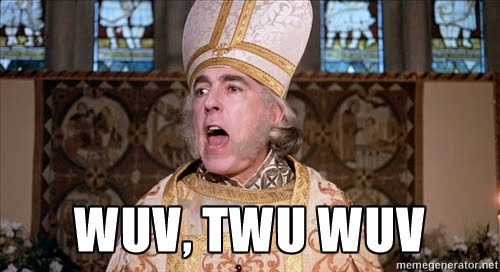
One more Princess Bride meme than you were expecting, right?
It's okay, just roll with it.

To Juliet, marrying Paris and realigning with her nuclear family, forsaking her new family of choice, would be the real death. That would be death and burial of her true self, and whatever lived on with Paris wouldn't be Juliet. So when she's faced with this non-choice, marrying Paris and subsuming herself or retaining herself and subjecting her physical body to starvation on the streets, what does she do? She finds door number three! She creates agency where none is freely available. She goes to the Friar and blackmails him into helping her escape with Romeo. And there's always the chance that something could go wrong here. Cue...

Choice 3: Happy dagger

When the plan falls through, which of course it does, Juliet again has a choice. She can live the rest of her life under someone else's terms by letting herself be found and returned to the Capulets. Or she can live the rest of her life under her own terms by ending it. Having just lost the only thing she was willing to take decisive action to obtain, the person who represented the freedom and the life she was building for herself, she trusts herself again and ends her life on her terms.

But wait, you're thinking, none of these choices seem particularly well-considered. I'm not sure I could fall in love with someone so quickly, or if that would even be love or just infatuation. If they survived long enough to actually live together as a married couple the shine would have gone off of that within a month.

You're right. And that's the whole point. In What, Lamb! What, Ladybird! we mention that the entire action of Romeo and Juliet takes place over just a few days. There's no time for the shine to come off or for anybody to make any considered decisions. These are reactions, not calculations. And that is fascinating to play. Juliet's objectives and through line are amazingly clear, and that makes her actions immediately understandable and relatable, no matter how far from what we would have done they may be.

Friday, March 18, 2016

Playing Hamlet

Playing Hamlet is, above all, intimidating. This is an old cliché, but like all of the oldest clichés, it has stuck to the collective consciousness for a reason: it is true. Hamlet gives us one of the most interesting considerations of suicide and the ending of life of any character in Western literature. Hamlet is Shakespeare to most. Not as Prospero is William Shakespeare the artist/magician; rather, Hamlet embodies the struggle between the self-fashioning philosophies of the Renaissance with the order and heroism of the Medieval that animates, to my mind, the very heart of Shakespeare’s work. “What is I?” has always seemed like Shakespeare’s most persistent question, and Hamlet is that question made flesh and interesting and dramatic.

Hamlet (Alex Dabertin) prepares to kill the
King (John Walbolt) in Bad Quarto's Hamlet

How do I embody all that? Obviously I cannot, but I must try.

Most actors get to be supported in this mad, open, painful endeavor by a cast and director they meet in the flesh every day or a few times a week. They get to be grieved and sallied together, and the actor playing Hamlet can let himself be as much of an ensemble member as he is able, which, in my consideration, is the best thing any actor can do. I, on the other hand, must struggle almost alone.

Some romantic teenagers, some Hamlets, out there might think that I am lucky, that my near complete autonomy allows me to find my true Hamlet, a Hamlet more original and more real than any other. Unfortunately, an actor, at least this actor, is not an original creature—we imitate at start and move from there: reacting, pushing, and seeing what happens outside. Completely original emotional fabrication on the part of an actor has a name: “camp.” And Hamlet does the solitary actor no favors. All of Hamlet’s greatest soliloquies (or part soliloquy, depending on what text one uses), are direct reactions to what is happening onstage, and many of Hamlet’s most powerful emotional beats spur forth while he is surrounded, none of which I can practice ahead of time. It is the confusion around him that reflects and feeds his struggle.

Bad Quarto Productions force me to develop my part in a near vacuum and in that way make me work in almost the purest form of theatrical acting. I must first hone my breathing and my mental casting so that I can imagine many possible reactions to my lines and make all of the options supported. I must be aware that I am being observed and try to make myself a dynamic stage presence, and most of all, for Hamlet, I must make sure my images are crystal clear. It is the montage of my mental images, their juxtaposition, order, and duration, which embodies the sole creative portion of my acting process. The rest are following certain rules, at best creatively, yes, but overall line memorization and movement are basically rote activities—as modern convention mostly desires them to be. My mental life, however, is entirely mine, and in a Bad Quarto production, it is almost untainted

This is not a necessarily good thing. While, yes, this autonomy makes me feel good, it does not always mean that I see the forest for the trees, or even that I have seen the trees as they are at all. This monomania is the reason why directors exist, I find. Tony nudges me to look again at the text I am speaking: what is the cadence the verse wants me to use? Should I agree or go against the grain? What is happening? Why does Hamlet say these things? Actors need directors. Young actors need them more.

I have been so influenced by all the Hamlets I have seen, and all the classes I have taken on the Prince…and my own particular biases—such as the fact that my father died when I was very young and so have never really had the feeling Hamlet has, the fact that I sometimes hate men as a rule, particularly when they are cruel to women—that I could not see certain developments in the text. The most important of these interactions was directed around the “nunnery” scene.

I could find nothing but Hamlet’s unnecessary misogynist tirade against Ofelia. I could neither forgive him nor understand him. I almost did not want to. It was at this time that Tony took me by the hand and led me through my trepidation to an understanding that felt much more natural and real than I could before have hoped. That being said, Tony and I disagree sometimes too. Directors also need actors to deflate their own assumptions, too.

Influence has been a problem in another way in this process as well: the undue influence of the Second Quarto and Folio texts of Hamlet. Often I have found myself slipping into the more famous verse rather than the more contradictory lines of our working text. The example that most comes to mind is “that puzzles the will,” rather than “that puzzles the brain and confound the sense.” Easy enough to see why the mind gravitates towards the more common version, but that is no excuse. This textual sensitivity—and the directness of the first quarto—has been a boon, however. I must be more concerned about what the real goal of Hamlet’s words is because I must speak words I do not think of as Hamlet’s. In a way, that makes them more mine than any of my friends’ previous turns as Hamlet.

I have very little more to say about Hamlet. I am still nailing down all of my lines; I am still finding out what I will be when I am on stage; I am still in process. This is a good place to be…but it is terrifying. I want to be so perfectly settled that no one can tell I am human, that would make me feel safe. It would be terrible theater, but I could do my job.

In the end, I will have to be terrified onstage, which, I think and hope, will allow me to touch the most visceral aspect of Hamlet’s life as we see it onstage: his terror and confusion. Hamlet is smarter than pretty much everybody onstage, but too often that translates into him being shown as some Bugs Bunny like infallible being. I do not want that. I want my Hamlet, if nothing else, to be achingly human, afraid, and confused, as I feel he should be. I now can only do the work to make sure that my terror is not hollowly mine but Hamlet’s as well.   

Wednesday, October 28, 2015

A Dramaturg's Thoughts on the Production Footage

As the dramaturg for this production I mostly wrote these blog posts over the last couple months. Living on a different continent, I won’t be able to attend any of the performances, but Tony asked me if I’d like to watch some production footage and write a few thoughts on the show, so here I am! Here are some things about the performance that seemed especially strong:


  • How well the actors had prepared. Each actor gave a strong, dedicated and shining performance. I kept being impressed by different actors as they gave their individual speeches, maintained separate personas for each character they played and really brought their “A game” to this endeavor.


  • How quickly the actors were becoming a company. In most shows the actors have a lot of time to build up a rapport with one another. There’s a whole run of rehearsals, and maybe bonding exercises. In Shakespeare’s day the core of a particular company often stayed together for years, and produced hundreds of shows together, one can only imagine the teamwork they would display. It was something I looked for in the footage I could see of Taming, and what I saw was a group of actors vigorously accepting each other’s choices, and running together. I saw laughter as they got ready to sing together, I saw chemistry in the couples, I saw enthusiasm in the dialogue (dialogue that they’d only been able to rehearse together over one day?) This struck me as one of the most impressive parts of the show. These actors embraced their identity as a team, and together, really sold the show, and I could tell that that unity would only grow as they became more and more comfortable with each other.  


  • The tricky bits of staging. There were so many pieces of the play that required special attention. The singing, the stage combat, (complete with ukulele and an over the shoulder carry!) the massive group scenes all of which take a lot of rehearsal time in normal circumstances, all looked as though the actors trusted each other and were totally in control of the situation.


  • How much attention everyone paid to the text. While this was true of the actor’s delivery, it was also true of the costume choices. Ferando did have a red cap! The various servants did wear their master’s colors and insignia when described. When substitutions were made (for the various foods mentioned) the actors clearly sold the cookies or crackers as the “Beef and mustard” or whatever food it was supposed to represent.


  • How well this text works as a play. Despite working on this play as a dramaturg I am still much more familiar with Shakespeare’s Taming of the Shrew version from the folio, and this is the first time I’ve seen the bad quarto version staged. I was totally delighted by the pair of younger sisters, and I really enjoyed how much the cast brought out the protofeminist leanings of this text as opposed to the folio.

Those are my thoughts for now! On a more personal note, I’d love to congratulations to the cast and crew on such a fun show, and thanks to Tony for asking me to work on this project with him. It’s been great being part of the team.